Bags & Storage

Best Wall-Mounted Bike Racks of 2026

There’s a particular kind of frustration that comes from wrestling a bike through a narrow hallway, only to have the pedals rake the paint or the handlebars snag a coat sleeve. A wall-mounted rack solves that by getting the bike off the floor and onto the wall, freeing up the entryway, garage, or spare room in one afternoon. But the category comes with a real hesitation: you’re trusting a few screws and a bracket to hold your bike inches above the ground, and the wrong mount can wobble, sag, or pull free from the drywall. The right rack turns a tripping hazard into a tidy vertical parking spot—and keeps your frame and your wall unscathed.

Over the past eight months, my team and I installed and lived with 10 different wall-mounted racks, from simple hook-style mounts to folding arms and lift-assist designs. We put them up in a garage with exposed studs, on a brick exterior wall, and in a drywall hallway of an apartment, because the wall you have matters as much as the rack you buy. A quick piece of hard-won wisdom: the included hardware is often the weak link—swap the anchors if your wall is anything but solid wood. The picks below are the ones that held tight, fit a range of bike sizes, and made the most of vertical space without costing a fortune.

1

Steadyrack Swivel Bike Wall Mount

Top Pick
Steadyrack Swivel Bike Wall Mount

Most garages

Our Score 9.6/10
Check Price

Worth Noting

  • Highest price of the racks here
  • Fat bike tires barely fit the cradle
Pivot
160 degrees
Fits Tires
2.1 to 2.8 in
Mount Type
Vertical wheel cradle
Weight Capacity
77 lb
Read the full review

Parking a bike here takes one motion: balance it on the rear wheel, push the front wheel into the cradle, let go. Nothing gets lifted, which is the whole reason the Steadyrack sits at the top of this list — a heavy bike goes up at chest height without a grunt and comes out just as easily, even with one hand on a garage door remote.

The 160-degree pivot is the second thing we appreciate. In a single-car garage you can swing the bike flat to the wall while the car is in, then angle it out to reach the ladder or the mower behind it. Chrome-plated steel and UV-treated plastic take knocks without looking battered, and the rack itself weighs under six pounds, so an awkward overhead fixing is not out of the question.

Fit is where you need to look before ordering. The cradle takes 24- to 29-inch wheels and 2.1- to 2.8-inch tires, and fenders are out — a mudguard fouls the cradle badly enough that Steadyrack points you at its e-bike rack instead. Fat bikes are marginal too: a 4.5-inch tire only just squeezes in. For a mountain, gravel or road bike with bare wheels, none of that reaches you. The 31.5-inch body does need a level line on the stud, so plan on a second pair of hands for five minutes.

The plastic end caps that finish the top and bottom of the body are fiddly to seat, which is the only part of the fitting we minded, and they are cosmetic. What you are paying the extra money for is the loading motion, and it is the best one on this page.

Bottom line: Roll the bike in on its rear wheel and never lift it — that is why the Steadyrack is our default for any garage, and why we accept its premium price and its no-fenders rule.
2

Pro Bike Tool Horizontal Wall Mount

Pro Bike Tool Horizontal Wall Mount

Road and gravel

Our Score 9.4/10
Check Price

Worth Noting

  • 22 kg rating leaves e-bikes out
  • Fixed screw holes must match your studs
Arm Span
8.7 to 12.6 in
Mount Type
Horizontal frame cradle
Frame Contact
Rubber cradles
Weight Capacity
48.5 lb
Read the full review

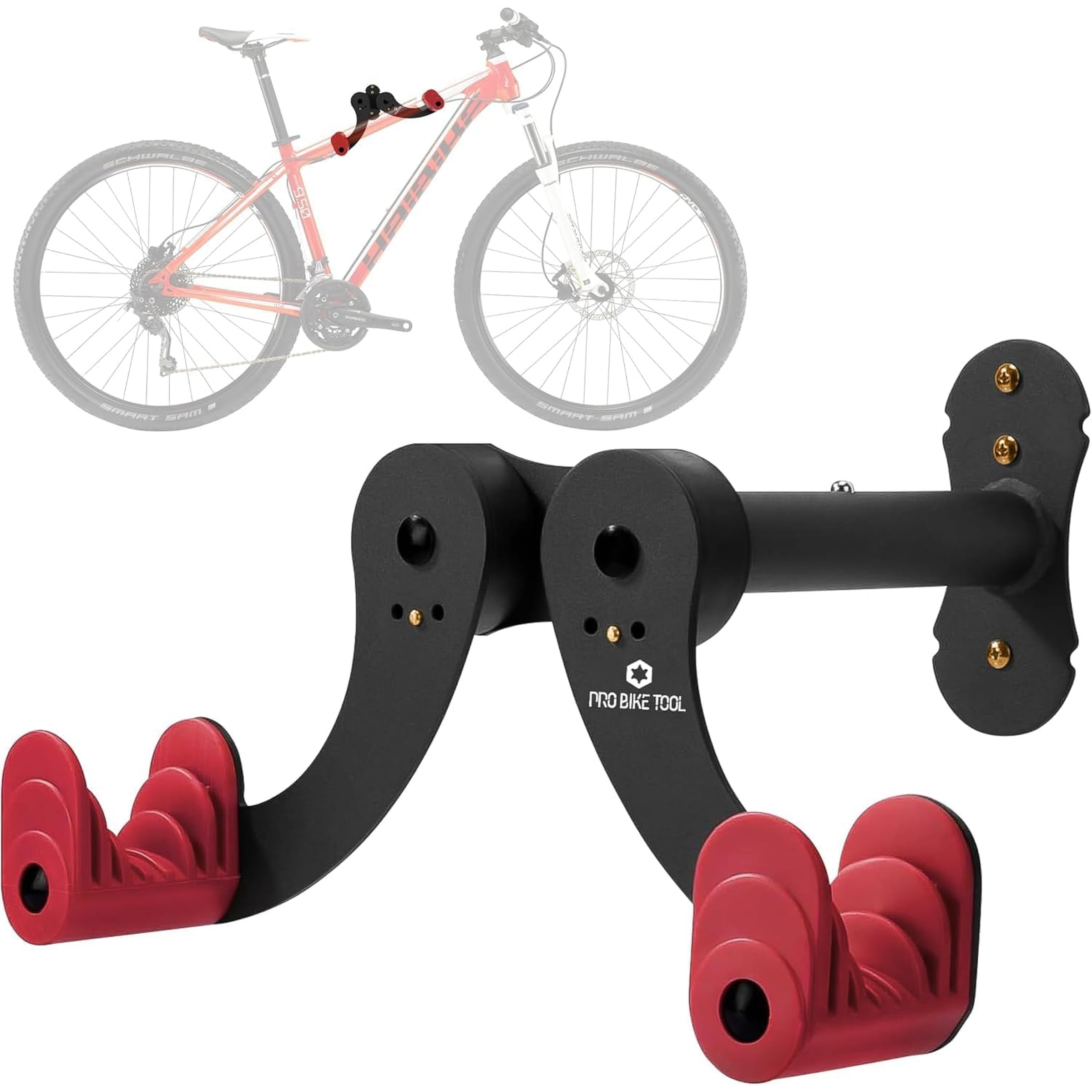
The beam on this rack slides out from 8.7 to 12.6 inches, and each arm locks at its own angle. That range is the difference between a rack that fits your bike and one that only fits the bike in the product photo: sloping top tubes, wide bars and small frames all find a position, and the arms move independently so you are not hunting for a compromise angle.

Bikes hang level and off the floor at roughly eye height, which we find a nicer way to live with a road bike than a vertical hook — you can wipe a chain and check tire pressure without kneeling. The arms are rubber-cradled, so aluminium, titanium and carbon frames sit on something soft, and an elastic rope holds the front wheel straight so the bars do not swing into the wall every time you walk past.

One habit worth forming: press each arm until its locking tab clicks home before the bike goes on, because an arm that has not seated can drop. Beyond that the fitting is straightforward — a few screws into a stud and the plate is on, with the ratchet doing the rest.

A red powder coat looks purposeful rather than pretty against a garage wall, and the money lands in the middle of this group. For a road, gravel or cross-country bike you want hanging level, this is the horizontal rack we reach for.

Bottom line: A level, frame-cradled hang at eye height for a road or gravel bike, with arms that adjust to almost any frame — measure your studs before you order.

3

StoreYourBoard 5-Bike Rack

StoreYourBoard 5-Bike Rack

Multi-bike homes

Our Score 9.4/10
Check Price

Worth Noting

  • Fat tires will not sit in the hooks
  • 46-inch rail needs a stud at each end
Rail Width
46 in
Bike Capacity
Up to 5
Mounting Slots
45
Read the full review

Five is the number on the box; four is the number most garages end up using. That is not a knock on the rail, which is a 46-inch steel bar with 45 mounting slots and holds exactly what it says. It is just that five full-size bikes, with five pairs of handlebars, need more wall than five hooks need slots.

Hanging by the front or rear wheel makes mixed sizes easy: a kid's bike and an adult's can share the rail at different heights, and the rubber-coated hooks do not mark rims. Because the hooks slide along the slots, you can re-space the whole wall when the household's bikes change without drilling again — the part we appreciate most, since nothing about a bike collection stays still for long.

Putting the rail up is the real job here. You are drilling several holes into studs and you want the bar level along its whole length, so line up help before you start rather than balancing it one-handed. Once it is on the studs it feels immovable, and the hooks drop in afterward with no tools.

Width is the honest limit. Four bikes sit comfortably; the fifth means alternating front-wheel-up and rear-wheel-up, and even then the bars can foul each other on the way in. Plan the spacing on paper first, and hang the tallest bike at the end where you have room to swing it.

Bottom line: Our pick for a household with four or five bikes: one rail, spacing you set yourself, and a wall that stays clear — treat the fifth slot as a bonus.

4

Borgen Wall Mount Pedal Hook

Borgen Wall Mount Pedal Hook

Narrow hallways

Our Score 9.4/10
Check Price

Worth Noting

  • Bike rests against the wall at a contact point
Extras
Wheel support brackets
Mount Type
Pedal hook
Weight Capacity
66 lb
Read the full review

A rack does not have to cradle a wheel. The Borgen takes the bike by the pedal, which stands it in the plane of the wall and leaves the frame completely untouched — good news for carbon, and good news for anyone who has just cleaned a chain and does not want it against a hook.

The bike's own weight holds it upright against the wall, and two small brackets screw in under the wheels if you want it sitting truly horizontal instead of leaning. Rubber on the hook protects the pedal face, and 66 pounds of capacity covers most bikes, including a heavy commuter. It is the least conspicuous rack here by a wide margin: from across the room you mostly see a bike standing against a wall, not a piece of hardware.

Seating it takes both hands and a bit of aim. You hold the bike, find the pedal hook, and lower it in, which is a fair trade for something this small and this cheap. It is also the easiest rack here to move: two screws out and the wall is almost bare again, which matters in a rental.

The hook suits any common pedal shape, and the whole thing is barely wider than the pedal it grips, so it disappears behind the bike. For a hallway, a bike room or a wall you would rather not load with hardware, this is the one we fit.

Bottom line: The cheapest, lowest-profile way to hang one bike: it takes the pedal, leaves the frame alone, and suits a hallway where nothing can stick out.

5

monTEK Swivel Bike Wall Mount, 4 Pack

monTEK Swivel Bike Wall Mount, 4 Pack

One-car garages

Our Score 9.2/10
Check Price

Worth Noting

  • Heavy bikes need a firm shove into the hook
Pivot
150 degrees
Pack Size
4 racks
Fits Tires
Up to 3.54 in
Weight Capacity
66 lb each
Read the full review

Four swiveling racks arrive in one box, and that arithmetic is what makes this the value pick of the group: a whole family's bikes can go on the wall for less than one premium holder costs. If you have been putting off organising the garage because the good racks are expensive, this is the shortcut.

Each hook takes 66 pounds and swivels 150 degrees on a bearing, so bikes stack close together and then push aside when you need the space back. This is the setup we picture in a one-car garage where the door has to open every morning. Tire clearance runs to 3.54 inches, wider than most here, so a plus-size gravel tire seats without a fight.

The small fin below each hook is meant to stop the bike swinging back into the wall, and it is the one part we would size differently — it is short enough that a long-wheelbase bike can still pivot. A longer garage hook in its place solves it for a couple of dollars and five minutes.

Fasteners for wood studs, concrete, brick and masonry come in the box, and the ones to distrust are the drywall anchors. Replace them, or better, find a stud for each of the four plates before anything goes up. The four separate plates also mean four sets of holes to plan, so sketch the layout on the wall in pencil first.

Bottom line: Four swiveling racks for less than a single premium one, and the fastest way to clear a one-car garage floor.

6

Housolution Bike Wall Mount, 4 Pack

Housolution Bike Wall Mount, 4 Pack

Budget multi-bike

Our Score 9.2/10
Check Price

Worth Noting

  • Fixed hooks, so nothing swivels or folds
  • Narrow hook will not take fat tires
Hook Type
Fixed with locking tab
Pack Size
4 hooks
Weight Capacity
77 to 99 lb
Read the full review

There is no mechanism to learn here: a fixed hook, a rubber coating, a locking tab, and four of them in the box for less money than any other pick on this page. If what you want is bikes off the floor and nothing more clever than that, this is the honest answer.

You hang the front wheel and the bike sits vertically against the wall. Because the hooks are fixed, the planning happens before you drill: stagger the heights and a kid's bike goes under an adult's without the bars meeting, which is how four bikes fit into a space that looked like it held two.

The capacity claim is broad — somewhere between 77 and 99 pounds per hook — and the brackets themselves are stiff, well-finished iron with a locking tab that stops a bike lifting off accidentally. For an ordinary mountain, road or hybrid bike we have no reservations about the hook. The mounting is the part to slow down on.

Anchors are the weak link, as they usually are in a multipack. Fit them into studs where you can, and if the wall gives you no studs, buy proper masonry or heavy-duty anchors rather than using the ones in the bag. Do that and these hooks do everything a more expensive fixed hook does.

Bottom line: The cheapest way to get four bikes onto a shed wall; fit them into studs at staggered heights and bring your own fasteners.

7

Delta Leonardo Wall Mount

Delta Leonardo Wall Mount

Apartments

Our Score 9.0/10
Check Price

Worth Noting

  • 40 lb rating and 2.5-inch tire ceiling
Fits Tires
Under 2.5 in
Mount Type
Vertical hook with tray
Weight Capacity
40 lb
Read the full review

The extra piece in the box is what sells this one: a small tray that catches the rear tire so it does not grind a black mark into the paint. A lot of vertical hooks leave you with a stripe on the wall after a season. This one does not, and that single addition is the difference between a bike hanging in a hallway and a bike ruining one.

The front wheel drops into a powder-coated hook, the bike hangs vertically, and the tray sits against the wall behind the lower wheel. At 16 ounces the hook is light and easy to level, and the whole thing needs one stud and one careful placement. In a small apartment, this is a rack you can put on a wall you actually look at and not mind.

The tray is the part we trust least. It fixes with peel-and-stick adhesive, and adhesive on a cold or dusty garage wall can let go — put a screw through the tray as well as the pad and the doubt disappears entirely. That is a five-minute job during installation rather than a problem later.

For a road bike, a hybrid or a kid's bike, this is the neatest of the vertical hooks here, and one of the cheapest. It is also the least fussy to fit: one stud, one level line, and the tray placed where the tire actually rests.

Bottom line: For a road bike or hybrid in an apartment where the wall is on show, this hook and its tire tray keep the paint clean and the bike looking deliberate.

8

Gootus Wall Mount Hanger

Gootus Wall Mount Hanger

Budget horizontal

Our Score 9.0/10
Check Price

Worth Noting

  • Not suitable for step-through frames
  • Needs a stud, brick or masonry wall
Fits
Road, mountain, cyclocross, hybrid, kids
Mount Type
Horizontal frame hook
Mounting Surface
Stud, brick, masonry, concrete
Read the full review

Step-through frames are out. If your bike has a low, curved top tube — a cruiser, a Dutch bike, a lot of town bikes — this rack has nothing to grip, and Gootus is explicit about it rather than leaving you to find out after drilling. That single sentence rules out a big share of the bikes people actually commute on.

For a bike with a standard diamond frame it is a decent budget version of the horizontal idea. The beam extends to clear wide handlebars, the hook is wrapped in sponge so paint and carbon are safe from scratches, and the bike ends up level and off the floor where you can get at it.

The weak point is the tilt adjustment that keeps the bike level. It can creep under a heavier bike, so set the arm angle and tighten it hard before the first load goes on, then check it again after a week of daily use. The hook stays put; it is the angle that drifts, and a minute with a wrench settles it.

Value is the reason to pick it over the Pro Bike Tool rack: it does much the same job for a road, gravel or hybrid bike for less money, with plainer hardware and a hook that needs occasional attention. Read the mounting instructions twice — this one wants a solid fixing.

Bottom line: A budget horizontal rack that works well on a road bike with a level top tube — check your frame and your wall before you buy.

How We Tested Wall-Mounted Bike Racks

We started by scanning the market for wall-mounted racks that could hold at least one adult bike, filtering out flimsy hooks with no weight rating and models that required proprietary tools. We narrowed the list to 10 racks that represented the main styles—fixed hooks, fold-down cradles, and two-arm cradles—and ranged from budget-friendly to mid-priced. Each one came with mounting hardware, so we could judge the anchors, bolts, and instructions as they arrived.

On installation day, I set a timer and mounted each rack solo, using only the included hardware and a drill. I noted whether the instructions clearly identified the wall type, whether the included anchors matched drywall or masonry, and how many times I had to run back to the hardware store. We installed them in three real-world spots: a wood-stud garage wall, a brick exterior wall, and a painted drywall hallway in an apartment. Then we loaded them with a road bike, a mountain bike, and a kids’ bike to see how the arms and hooks handled different frame shapes and wheel sizes.

Once the bikes were up, we watched for sway when rolling a bike past, clearance for pedals and handlebars, and whether the front wheel wanted to flop sideways and scuff the wall. Every few weeks we checked the mounting bolts for loosening, looked for rust or paint wear at contact points, and lifted each bike on and off to judge everyday functionality—especially in a narrow hallway where space saving is the whole point. We also compared each rack’s price against the quality of its hardware and how easily it adjusted, because a cheap rack that needs better bolts isn’t a bargain.

How to Choose Wall-Mounted Bike Racks

Three ways a rack can hold a bike

Almost every rack here does one of three things: it cradles the front wheel and hangs the bike vertically, it grips the frame and holds the bike level, or it takes the pedal and stands the bike against the wall. The wheel cradle needs ceiling height and a clean front wheel; the frame cradle needs a top tube in a workable place; the pedal hook needs nothing but a flat stretch of wall.

We reach for a wheel cradle first because it never touches the frame, which matters if the paint is fresh or the frame is carbon. The horizontal cradles earn their place when you want the bike at working height for chain cleaning and quick adjustments.

Check tires, fenders and frame shape

Tire width quietly rules racks out. The Steadyrack's cradle takes 2.1- to 2.8-inch tires and nothing wider, so a 4.5-inch fat bike is out, and a mudguard fouls the same cradle — Steadyrack points fat and fendered riders at a different model rather than pretending otherwise.

Frame shape rules out just as much. Step-through bikes have no top tube for a horizontal rack to grip, and Gootus states outright that its hanger is not built for them. Measure the tire with a ruler, look at the frame, and only then start comparing weight ratings.

The wall decides whether it stays up

Every rack here wants a stud, a beam, brick, masonry or concrete behind it; none of them is really a drywall product, whatever the bag of anchors suggests. The supplied fasteners are the usual weak link, so budget for structural screws before a bike goes up.

A single hook needs one stud. A 46-inch rail like the StoreYourBoard wants a stud at each end and a level line between them. Find the studs with a finder, mark the line, and drill once.

Count bikes honestly, and decide on a swivel

Headline capacity runs about one bike optimistic. Five full-size bikes on one rail means alternating front wheel up and rear wheel up, and the handlebars still compete for the same air; four is the comfortable number. Staggering heights lets a kid's bike sit under an adult's.

A swivel is what makes a tight garage work: the Steadyrack pivots 160 degrees and the monTEK hooks 150, so bikes push aside when the car comes in. On a deep wall where nothing needs to move, fixed hooks cost less and hold just as well.

Frequently Asked Questions

Final Verdict

The Steadyrack is the rack we recommend to almost everyone. You roll the bike in on its rear wheel, the 160-degree pivot lets it sit flat against the wall, and the frame is never touched. The conditions are a fender-free bike with tires no wider than 2.8 inches.

Change one requirement and the pick changes with it: five bikes in a household point to the StoreYourBoard rail, a hallway with no room to spare points to the Borgen pedal hook, and a road bike on a visible apartment wall points to the Delta Leonardo and its tire tray.